Testosterone Blood Test UK: What It Checks, When to Test and How to Prepare
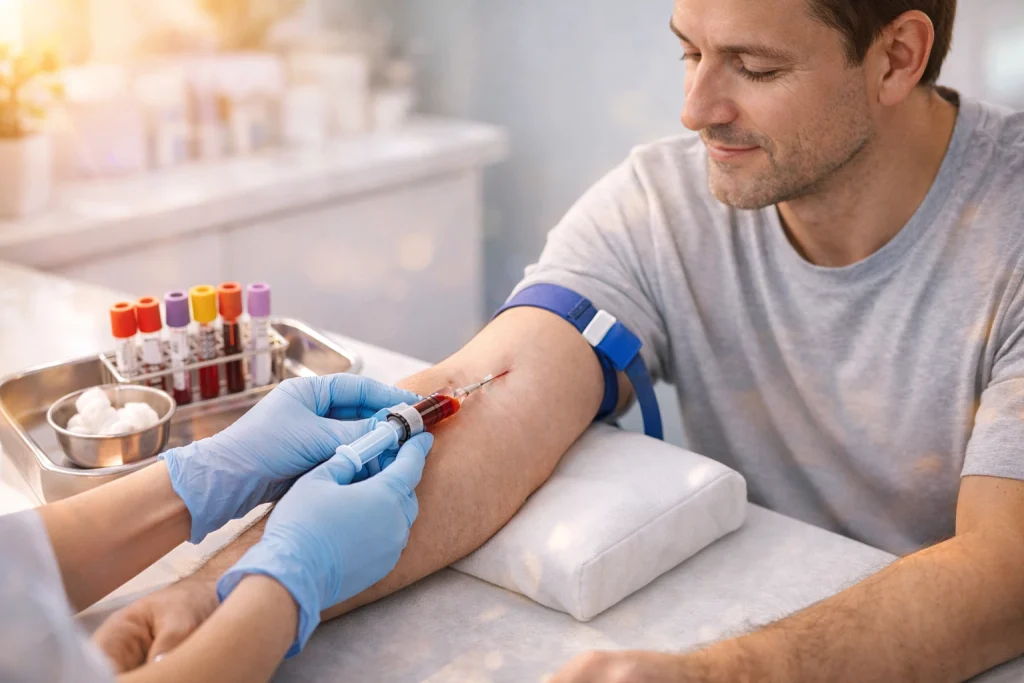
Interest in testosterone testing has increased considerably as more men become proactive about their health, fitness, energy levels and hormonal wellbeing.
It is now easy to find private testosterone blood tests online in the UK.
But ordering the test is only one part of the process.
Some kits require a finger-prick sample, while more comprehensive hormone panels may require blood to be collected from a vein by a trained phlebotomist.
There are also important questions to consider before testing:
What does a testosterone blood test actually measure? When should the sample be collected? Can low testosterone be diagnosed from one result? And what should you do if your private test kit requires a venous sample?
This guide explains the basics.
What Is Testosterone?
Testosterone is a hormone that plays an important role in the body.
Although testosterone is present in both men and women, men generally have considerably higher levels.
In men, testosterone is primarily produced by the testes and is involved in areas including:
- Sexual development
- Sex drive
- Sperm production
- Muscle and bone health
- Red blood cell production
- Body composition
Testosterone levels are not static.
They can vary according to factors including age, time of day, health conditions and individual circumstances.
This makes correct testing and appropriate medical interpretation important.
What Is a Testosterone Blood Test?
A testosterone blood test measures the amount of testosterone present in a sample of your blood.
Depending on why testing has been requested, testosterone may be measured on its own or as part of a wider hormone panel.
A healthcare professional might request testing when investigating symptoms or monitoring an existing medical condition or treatment.
Private health companies also offer testosterone tests and men’s health panels to people who want to investigate their hormone levels.
However, the presence of symptoms does not automatically mean that testosterone is the cause.
This is why results should be considered alongside your symptoms, medical history and any other tests requested by a qualified healthcare professional.
Why Might Someone Have Their Testosterone Tested?
There are many reasons why testosterone testing may be discussed.
A healthcare professional may investigate hormone levels when someone reports relevant symptoms or when there is another medical reason for testing.
Symptoms that may lead someone to discuss testosterone with their doctor can include:
- Reduced sex drive
- Changes in erectile function
- Reduced energy
- Changes in muscle mass
- Changes in body composition
- Fertility concerns
- Mood changes
- Reduced shaving or body-hair growth in some cases
These symptoms are not specific to testosterone deficiency.
Fatigue, for example, has many possible causes.
Sleep problems, anaemia, thyroid conditions, mental health difficulties, lifestyle factors, medication and numerous other health conditions can produce overlapping symptoms.
A blood test therefore forms only one part of an appropriate medical assessment.
What Does a Male Hormone Blood Test Include?
This depends entirely on the panel selected or the tests requested by your clinician.
A basic test may measure total testosterone.
A more comprehensive male hormone panel may include additional biomarkers.
Examples can include:
Total Testosterone
Total testosterone measures testosterone circulating within your bloodstream, including testosterone attached to proteins.
SHBG
SHBG stands for sex hormone-binding globulin.
It is a protein that binds to sex hormones, including testosterone.
Measuring SHBG alongside testosterone can sometimes provide additional information when assessing hormone status.
Free Testosterone
Only a proportion of testosterone circulates without being tightly bound to proteins.
Depending on the laboratory and clinical circumstances, free testosterone may be measured or calculated using other results.
LH
Luteinising hormone, or LH, is produced by the pituitary gland.
In men, it is involved in signalling the testes to produce testosterone.
FSH
Follicle-stimulating hormone, or FSH, is another pituitary hormone and plays an important role in reproductive function.
Prolactin
Prolactin is another hormone that may be investigated in some circumstances.
The exact combination of tests you need should be determined by the healthcare provider responsible for your testing.
Do not assume that purchasing the panel containing the largest number of biomarkers automatically provides the most useful information.
What Time Should a Testosterone Blood Test Be Taken?
Timing can matter when testosterone is being assessed.
Testosterone concentrations can change during the course of the day.
For this reason, your healthcare provider or testing laboratory may instruct you to have the sample collected during a particular period, often in the morning.
Follow the instructions provided with your test precisely.
This is particularly important when results will be compared against a laboratory’s reference range or used as part of a clinical assessment.
If your private testing provider specifies a collection window, mention it when arranging your mobile phlebotomy appointment.
Do You Need to Fast for a Testosterone Blood Test?
Requirements vary.
You should not assume that every testosterone test requires fasting or that every test can be performed after eating.
The instructions may also be affected by other biomarkers included in your test panel.
For example, a broad health panel containing hormone tests alongside metabolic tests may have preparation requirements that differ from a testosterone-only test.
Always check the instructions supplied by:
- Your GP
- Your specialist
- Your private doctor
- The laboratory
- The company that supplied your test kit
If fasting is required, the provider should tell you how long to fast and whether you may drink water.
Can You Test Testosterone at Home?
Yes, but the phrase “testosterone blood test at home” can refer to two different types of service.
Finger-Prick Home Testing
Some private testing companies provide kits that allow you to collect a small amount of capillary blood yourself using a finger-prick device.
You then return the sample to the laboratory.
This can be suitable for tests specifically designed and validated to use that type of sample.
Mobile Venous Blood Collection
Other tests require a sample taken from a vein.
In this situation, a trained phlebotomist can visit your home, workplace or another appropriate location and collect the sample professionally.
This can be particularly useful for larger male hormone panels or private testing kits supplied with venous collection tubes.
Before arranging your appointment, confirm which type of sample your laboratory requires.
Why Do Some Private Test Kits Need a Venous Sample?
A finger-prick produces a relatively small blood sample.
Some tests require:
- A greater volume of blood
- Multiple collection tubes
- Particular types of collection tube
- Specific sample-processing requirements
In these cases, venous blood collection may be required.
If your private testosterone or male hormone kit contains blood collection tubes and instructions for professional venepuncture, you will need an appropriately trained person to collect the sample.
BloodSample360 supports clients who already have compatible private test kits and require professional blood collection.
How Mobile Phlebotomy Works with a Private Testosterone Test
The process is straightforward.
Step 1: Order or Obtain Your Test
Your test may be requested by your GP, consultant or another healthcare professional.
Alternatively, you may purchase an appropriate test from a private laboratory or healthcare provider.
Step 2: Check the Collection Requirements
Read the instructions carefully.
Confirm:
- Whether venous blood is required
- Which tubes are needed
- Whether fasting is required
- The recommended collection time
- How the sample must be returned
- Whether special handling is required
Step 3: Arrange Your Blood Collection
Book a mobile blood draw at a time that meets your testing provider’s instructions.
Step 4: Have the Sample Collected
A trained phlebotomist attends your chosen location and collects the requested blood samples.
Step 5: Prepare the Sample for the Laboratory
The sample is labelled and handled according to the appropriate instructions.
Step 6: Laboratory Testing
Your designated laboratory performs the analysis.
Step 7: Receive Your Results
Results are provided according to the arrangements made with the organisation that requested or supplied your test.
BloodSample360 provides blood sample collection rather than medical interpretation.
Questions about your results should be directed to your doctor, laboratory or healthcare provider.
Can One Blood Test Diagnose Low Testosterone?
A single number should not be interpreted in isolation.
Hormone levels can vary, and the clinical significance of a result depends on more than whether a number is marked as high or low on a laboratory report.
Your healthcare professional may consider:
- Your symptoms
- Your age
- Your medical history
- The time your sample was collected
- Other laboratory results
- Medicines you take
- Previous results
If a result is unexpected or suggests a possible hormonal problem, additional testing may sometimes be recommended.
Do not start hormone treatment based solely on an online result without appropriate medical advice.
What Can Affect Testosterone Levels?
A range of factors can influence hormone measurements and overall testosterone status.
These can include:
- Age
- Sleep
- Acute illness
- Some long-term medical conditions
- Certain medications
- Weight and body composition
- Timing of sample collection
This is another reason why correct preparation and professional interpretation are important.
If the provider of your test gives specific preparation instructions, follow those instructions before your appointment.
What Should You Bring to a Mobile Testosterone Blood Test?
Having everything ready can prevent delays.
If you have ordered a private blood testing kit, have the entire kit available for the phlebotomist.
Depending on your test, this may include:
- Blood collection tubes
- Labels
- Laboratory request forms
- Your test activation details
- Packaging
- Return labels
- Collection instructions
If the test was requested by your GP or another healthcare provider, make sure you have the relevant blood test request form.
BloodSample360 does not supply the clinical blood test request itself.
Benefits of Mobile Blood Collection for Busy Men
For many people, the difficulty is not ordering a blood test.
It is finding time to have the sample collected.
No Additional Clinic Journey
Instead of travelling to a separate blood collection centre, the phlebotomist comes to you.
Less Disruption to Your Working Day
For professionals with demanding schedules, a mobile appointment can be easier to fit around work.
Privacy
Your blood can be collected in the privacy of your home or another suitable location.
Useful for Repeat Testing
People who have been advised by their healthcare provider to undergo repeat blood testing may find mobile collection particularly convenient.
Compatible with Many Private Kits
If your private test requires venous collection, mobile phlebotomy provides a convenient bridge between receiving your test kit and sending the completed sample to the laboratory.
Testosterone Testing Is Not Just for Bodybuilders
Online discussions sometimes make testosterone testing appear almost entirely related to gym performance and muscle building.
In reality, testosterone is a medical hormone, and testing has legitimate clinical uses.
If you are experiencing persistent symptoms that concern you, speak to a qualified healthcare professional rather than relying solely on fitness forums, social-media advice or self-diagnosis.
The goal of testing should be to obtain useful health information—not simply to chase a particular number.
What If Your Testosterone Result Is Low?
Do not panic.
A laboratory result requires context.
If you receive a result outside the laboratory’s reference range, contact the healthcare professional responsible for your test.
They can determine whether:
- Further investigation is required
- Repeat testing is appropriate
- Other hormone tests are needed
- Your symptoms may have another cause
- Treatment or referral should be considered
BloodSample360 does not diagnose testosterone deficiency or recommend hormone treatment.
Need a Venous Blood Draw for Your Private Test Kit?
If you have already purchased a private testosterone test, male hormone panel or general health kit requiring venous collection, arranging the blood draw does not need to mean spending part of your day travelling to a clinic.
BloodSample360 provides professional mobile phlebotomy services across Manchester, Cheshire and surrounding areas.
We can collect eligible blood samples at your home, workplace or another suitable location.
Our service is suitable for people with compatible private blood test kits as well as patients who have received blood test requests from their healthcare provider.
Book Your Mobile Blood Collection
Have you already received your testosterone or male hormone test kit?
Check the collection instructions and confirm that it requires a venous blood draw.
Then arrange a convenient appointment with BloodSample360.
A trained phlebotomist can come to your location, professionally collect the required samples and prepare them in accordance with the instructions supplied for your test.
Book your BloodSample360 mobile blood collection appointment today and complete your private blood test without the unnecessary journey to a traditional blood collection clinic.
This article is for general information only and does not provide medical advice, diagnosis or treatment. If you are concerned about symptoms or your hormone levels, speak to a GP or another appropriately qualified healthcare professional.